Price your services with confidence, not guesswork
Ask most clinic owners how a consultation fee was set and the honest answer is “it felt right” or “it is what everyone charges.” Both are how practices quietly work for free. By the end of this, you will have a price you can defend in one sentence — and a floor you will never go below.
Because price is a signal before it is a number. When you are cheap, the patient’s brain whispers — “maybe he is not that good.” The clinic charging half your price is not generous. It is broadcasting insecurity.
Rule onefind your real cost per service
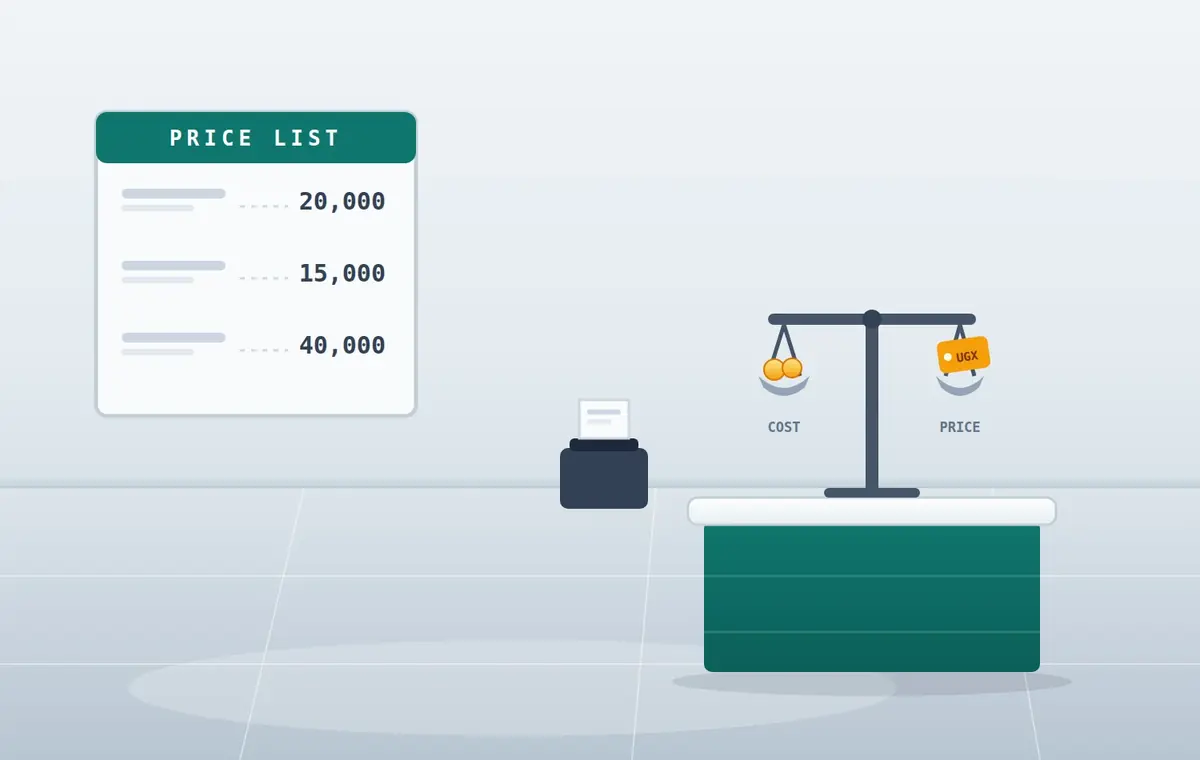
Take one service — say, a routine consultation. Add the clinician time it consumes, a share of reception and cleaning time, consumables, rent, and utilities for the room and minutes it occupies. Ugly, boring arithmetic — but it produces the only number that matters: your cost floor.
Anything priced below that floor loses money on every patient. You would be surprised how many “affordable” services in a typical price list sit below it. The consultation that “feels” profitable is often the one eating you — because the twenty minutes of nurse time, the gloves, the power, the fraction of rent, were never in your number.
Pick your busiest service right now. Can you say — to the nearest shilling — what it costs you to deliver? If the number came from your head, it is wrong.
Rule twoprice the value, not just the cost
The floor tells you where you cannot go. Above it, price on speed, certainty, and comfort — the things patients actually pay for. A same-day lab result is worth more than a next-week one, even if the reagents cost the same.
The pharmacy on the corner sells the same amoxicillin you do. What they cannot sell is your diagnosis, your referral network, and the twenty minutes of attention behind the prescription. Price that. Value pricing is not greed — it is matching the number to what the patient is actually buying: not the test, the answer. Not the visit, the certainty.
- Anchor on outcomes and turnaround, not on consumables alone
- Offer a standard and a premium tier where speed or comfort differs
- Review prices quarterly — costs creep up long before you notice
Rule threekill the informal discount
The biggest threat to a price list is not a competitor — it is the exception. Every “just this once” discount rewrites your prices in the minds of staff and patients. Define who may discount, by how much, and record every one. What is recorded shrinks.
And the discount is rarely about kindness — it is about avoiding an awkward ten seconds. Those ten seconds, repeated twenty times a week, are a second rent payment. If you must give, give through a declared policy — a staff rate, a health camp, a published exemption. Never through an apology whispered at the desk.
A useful test: if you cannot explain in one sentence why a service costs what it costs, neither can your front desk — and the price will erode.
The review that keeps it honest
Pricing is not a document you laminate once. Costs creep — rent goes up, gloves go up, the dollar moves. Review quarterly: the price that was right in January can be below your floor by October. The clinic that reviews prices once a year discovers it spent six months working below cost.
A price you cannot explain in one sentence is a price you will lose in one negotiation. Know your floor. Price above it. Defend it. The patients who leave over price were never going to stay — and the ones who stay are paying for certainty they can see.
About the author

Joel Muwera
Founder, Ospito+ HMS
CEO, Nasa Healthcare & Surgery