How to Track Which Drugs Are Actually Making You Money
You have a shelf full of drugs. Some of them are making you rich. Some of them are quietly bankrupting you. And you have no idea which is which. By the end of this article, you will know exactly which drug in your clinic is your best employee — and which one is the thief stealing your salary. Stay with me, because the answer at the end is not what you think. The drug you believe is your biggest seller is probably your biggest loser.
Lie one"I know my best-selling drug"
No, you don’t. I guarantee this is happening in your clinic right now — you think your best-selling drug is the one you reorder most often. Coartem. Amoxicillin. Paracetamol. The ones that fly off the shelf. Here is the problem — selling a lot is not the same as making money. You could be selling a thousand boxes of paracetamol a month and making two shillings per box. That is two thousand shillings. For a thousand transactions. That is not a business. That is a hobby with stress.
What’s your best-selling drug? You probably answered in two seconds. Now — what’s your most profitable drug? …Silence. That is the problem. You are tracking volume, not value.
Lie two"I buy cheap, so I’m making profit"
This one hurts because it feels smart. You find a supplier who sells amoxicillin five hundred shillings cheaper than the others. You feel like a businessman. You stock up. But here is what you are not calculating — the transport to go pick them up. The time you spent negotiating. The fact that half of them expire before you sell them because you over-ordered to "get the discount".
Your profit is not made at the supplier — it is made at the point of sale. And if you don’t know what happens between buying and selling, the discount at the supplier is eating you alive.
Lie three"All my drugs make money"
Most doctors get this completely wrong — they assume that if they buy a drug for five thousand and sell it for seven, they are making two thousand profit. Clean. Simple. Wrong. What about the box that sat on the shelf for four months before it sold? What about the three boxes that expired and went in the bin? What about the two boxes the nurse gave away "to check" and never charged? Your real profit on that drug is not two thousand per box. It is closer to four hundred. And in some cases — it is negative. You are paying to keep that drug on your shelf.
Pick one drug in your clinic right now. Any drug. How much profit did it make you this month — after expired stock, after giveaways, after every hidden cost? …You don’t know. And that drug might be eating you.
Lie fourthe one nobody talks about
Now — lie number four. The one I teased at the start. The one nobody talks about. Your biggest seller is probably your biggest loser. The drug you reorder every week, the one patients ask for by name, the one that makes your clinic look busy — that drug might have a profit margin so thin it is practically charity. You are working hard to keep it in stock, and it is working hard to keep you broke.
Here is the truth — the drug that makes you the most money is probably one you barely notice. Something you sell less of, but at a margin three times higher. You are ignoring your goldmine because you are too busy restocking your graveyard.
Lie five"I’ll figure it out at the end of the month"
This might surprise you — by the end of the month, it is too late. The expired drugs are already in the bin. The overstocked slow-movers are already eating your cash. The understocked fast-movers already cost you patients who went elsewhere. You cannot fix dead stock at month-end. You can only mourn it.
When you do your stock count — is it to prevent losses, or to document them? Because there is a big difference. One makes you money. The other just makes you sad.
You should know — every week — which drugs are moving, which ones are sitting, and which ones are about to expire. Not at month-end. Not when the bin is already full. Weekly. Because a drug you catch in week two can be promoted, repriced, or moved. A drug you catch in week four is garbage.
Lie six"I price my drugs by adding a markup"
This is how every clinic does it. Buy price plus thirty percent. Done. Simple. And silently destructive. Because a flat markup treats every drug the same — and every drug is not the same. Fast-moving drugs with thin margins should carry a higher markup. Slow-moving drugs with long shelf lives can carry less. Drugs that nobody else stocks nearby? You can charge what they are worth. Drugs that every pharmacy on the corner also sells? You compete on convenience, not price.
A flat markup is lazy pricing. And lazy pricing is why your shelf is full of drugs that sell a lot, and earn nothing. Price each drug based on its movement, its margin, and its market — not on a formula you copied from someone who is also broke.
Lie seven"Stock is money in the bank"
A drug you bought three months ago has been sitting on your shelf, tying up cash you could have been earning. That is a cost. A drug that expires in two weeks is worth less today than it was last week. That is a cost. A drug you cannot restock because the supplier raised prices is worth more than you paid. That is a gain you are not capturing.
If you sold every drug on your shelf today at current selling prices — how much cash would you have? …You don’t know. And that not-knowing means you are sitting on money you cannot count, cannot use, and cannot grow.
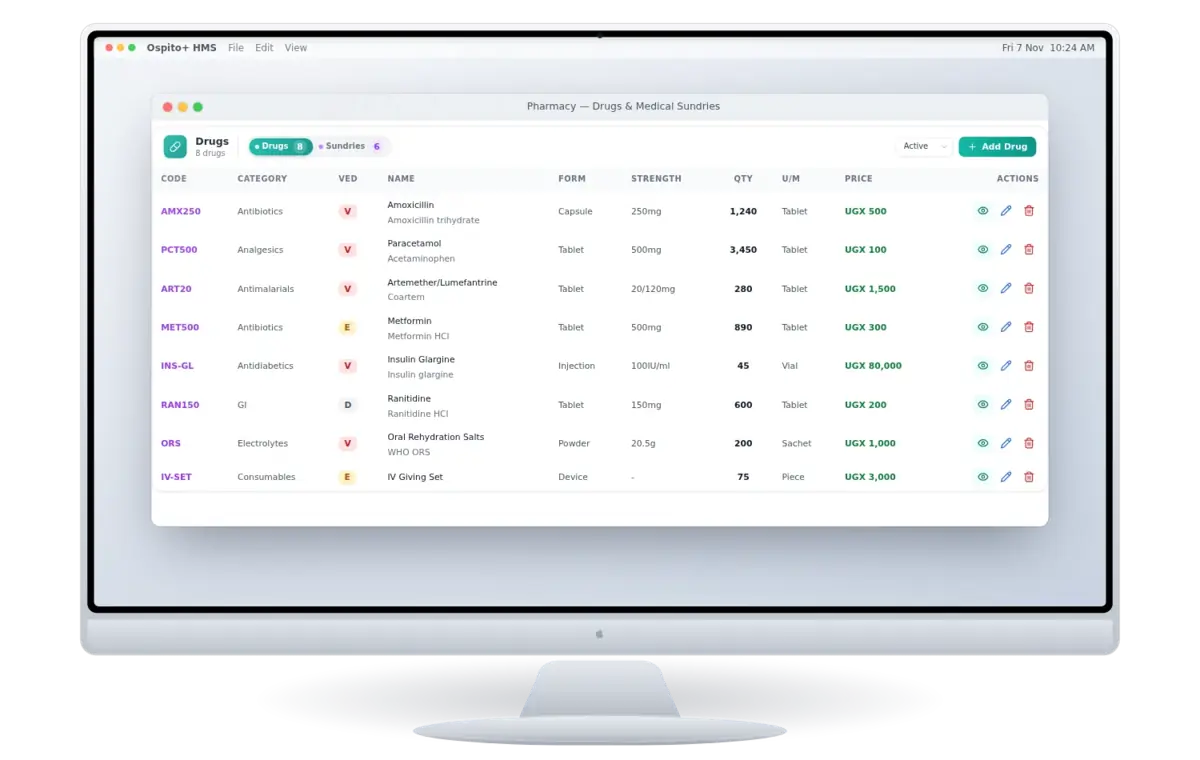
You need to find a way of knowing your stock valuation with ease — not what you paid, but what it is worth now, what is losing value, and what is tying up cash you need. Some hospital management systems show you your real-time stock value, your expiry risks, and your slow movers in one screen. Because stock that sits is not an asset. It is a prisoner holding your money hostage.
Lie eight"I don’t need to track drugs — just cash"
This is the lie that kills more clinics than any other. You count the money in the drawer and feel good. Twenty thousand today. Forty thousand yesterday. We are making money. But the drawer does not tell you that twelve thousand of today’s money is going to restock the drugs you just sold at break-even. The drawer does not tell you that eight thousand of yesterday’s money is gone because three boxes expired last week. The drawer tells you what came in. It never tells you what is about to go out.
Cash flow without stock flow is half the story. And running a clinic on half a story is how you stay busy and broke forever.
The method: best earner per day on shelf
Here is the payoff. The drug that makes you rich is the one that moves fast and earns enough. Not the one that moves slow and earns big once. The metric is not margin per sale — it is margin per day it sits on your shelf. Because a drug that sits for three months before it sells is tying up your money for ninety days. A drug that sells in three days at a smaller margin but turns over thirty times a month — that is your goldmine.
I stopped looking at "best seller" and started looking at "best earner per day on shelf". And the day I did, I cut my stock costs by forty percent and my profit went up. Not because I sold more — because I stopped stocking drugs that were pretending to be assets while they were actually eating my money.
Every drug on your shelf is either an employee or a tenant. The employees make you money. The tenants just live there, take up space, and eat your rent. Find out which is which. Fire the tenants. Promote the employees. And your clinic won’t just be busy — it will be profitable.
About the author

Joel Muwera
Founder, Ospito+ HMS
CEO, Nasa Healthcare & Surgery