Five numbers every clinic owner should check every Monday
Most clinic owners find out how their business is doing once a month — from an accountant, weeks after the damage is done. By then the money has leaked, the stock has expired, and the quiet week has become a quiet quarter. You are driving your clinic by looking in the rear-view mirror.
The fix is not a bigger report. It is a smaller one, checked more often. Five numbers, every Monday morning, before the week runs away from you. Fifteen minutes. No MBA required — just the discipline to look.
And do not confuse this with bookkeeping. Your accountant’s report tells you what happened last month. These five numbers tell you what is about to happen — while you can still change it.
Number onerevenue collected vs. revenue billed
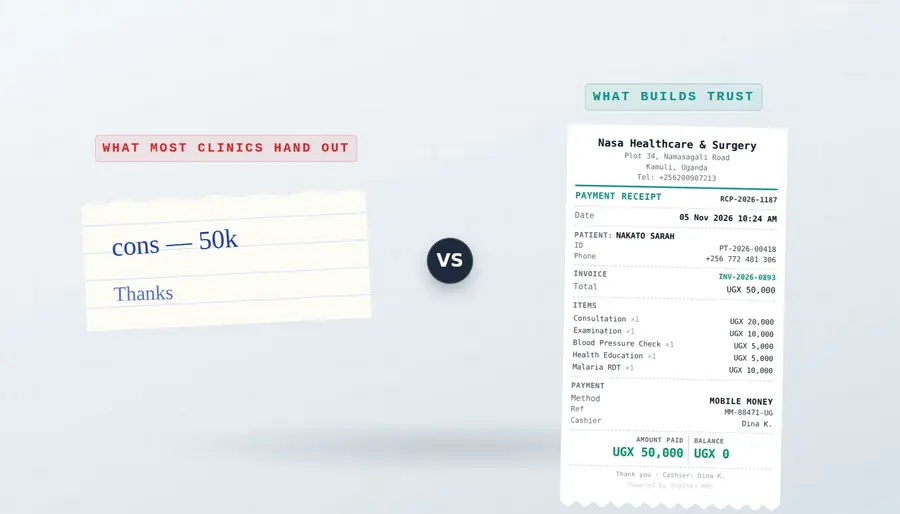
What you invoiced and what actually reached the till are rarely the same number. The gap is where unbilled services, informal discounts, and outright leakage live. If billed minus collected is more than 5%, someone at the front desk is giving away your margin — usually without meaning to.
Here is the trap — the gap never looks like a crisis. It looks like twenty thousand here, a “brother, just pay half” there. By Friday it is a nurse’s transport allowance. By the end of the quarter, it is a rent payment. And nobody stole it — it just left, politely, one small exception at a time.
Last Monday, what was the gap between what you billed and what you banked? If you had to think about it for more than a second — that is exactly the problem.
Number twodaily patient volume
Not monthly — daily. A month of “average” numbers hides the dead Tuesdays and the overwhelmed Saturdays. Volume by day of week tells you when to roster staff, when to run special clinics, and whether last week was a blip or a trend.
A quiet Monday you can explain — rain, a burial, a public holiday. Four quiet Mondays in a row is a trend. And a trend is a decision that has already been made about your clinic — by patients who stopped coming while you were busy not counting.
Number threeaverage ticket per visit
Total revenue divided by visits. If your ticket is falling while volume holds, patients are coming in but buying less — a sign that services are being under-prescribed, under-billed, or quietly skipped at the desk.
Watch it weekly and it becomes an early-warning system. A price war, a lazy biller, a shrinking service menu — all of them show up in this number first, weeks before they reach your bank account. It is the vital sign of your revenue the way temperature is the vital sign of a fever.
Number fourstock-outs and near-expiry count
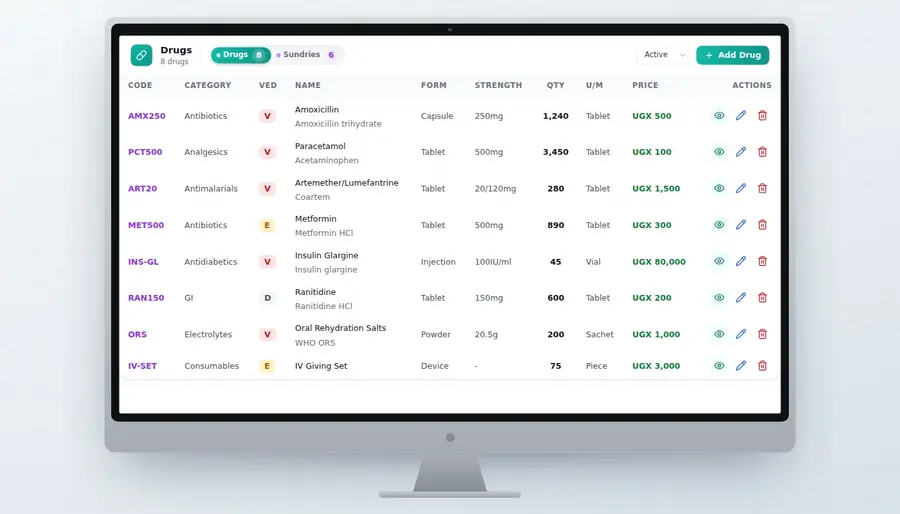
Two numbers, not one. Stock-outs tell you what revenue you lost because the shelf was empty. Near-expiry tells you what cash is about to become waste. Both are symptoms of the same problem: ordering by memory instead of by movement.
The shelf knows exactly what is happening on it. The question is whether you look before Friday’s patients arrive to an empty Coartem shelf — and walk to the clinic next door, where the shelf is full.
Number fiveoutstanding balances
Money owed to the practice ages badly. A debt that is 30 days old is collectable. A debt that is 90 days old is a donation. Watch the total weekly and set a rule for when follow-up happens — then actually follow up.
The rule: if a number needs more than fifteen minutes to assemble, it will not get checked. Put these five on one screen or one sheet — the format matters less than the ritual.
The ritual that makes it stick
Five numbers do nothing on a screen you never open. Same time, same place, same sheet — Monday morning, before the first patient, coffee in hand. Write them down or pull them from your system, and next Monday you compare this week to last. The comparison is the point: one week is a snapshot, four weeks is a direction.
And do not keep the numbers secret. Tell your nurse which ones matter to you. Staff who know what is being counted behave differently — visibility is accountability, and accountability is free.
None of this requires new staff or new software — though a system that already tracks billing, dispensing, and visits puts all five in front of you without anyone compiling a report. The discipline is the hard part, and it starts next Monday.
A clinic owner who checks five numbers every Monday is never surprised by their own business. The ones who are surprised find out at month-end — when the only thing left to do is absorb the loss.
About the author

Joel Muwera
Founder, Ospito+ HMS
CEO, Nasa Healthcare & Surgery